
blog
Patrick Oliver

Patent abuse hurts European SMEs and undermines the knowledge transfer process

This year World Intellectual Property Day focuses on SMEs. As the two examples below show, patents can be an SME’s worst enemy, as well as their best friend. Abuse by patent assertion entities is a serious and growing threat in Europe, especially to small and mid-size  innovative firms. The gaming of the European patent system must stop. 


Patents ought to be an SME’s best friend. They help attract finance and provide a route to commercial success, right? True, but that’s not the whole story. Increasingly SMEs are finding themselves at the wrong end of baseless patent litigation. Instead of sparking innovation the misuse of patents deters it.

Just like big corporations, SMEs find themselves the target of patent assertion entities (PAEs), also known as patent trolls. These organizations are in business solely to make money from patents they have acquired. They don’t invent things; nor do they produce anything. They often hide their true identity behind opaque networks of shell companies, often set up expressly to exploit just a single patent.

Their targets are faced with a stark choice: either engage in years of costly and time-consuming litigation or pay huge sums to settle.

Few victims speak out about their experience. The ones that go to court do at least leave a paper trail for public record.

But for those that settle out of court there is no record of their experience at the hands of PAEs. While it is impossible to say precisely how many firms settle, it is clear that the cases that get to court are just the tip of the iceberg.
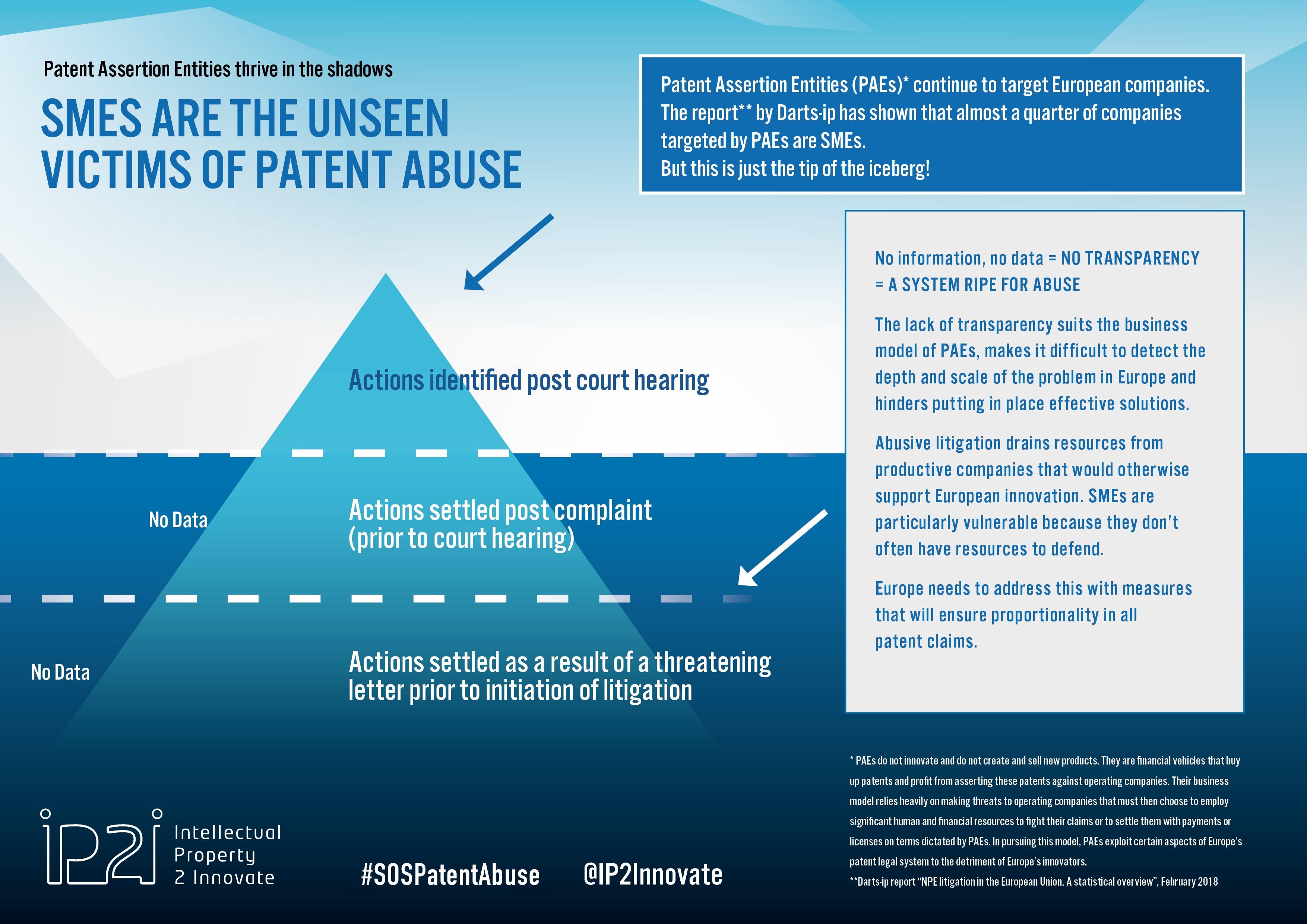
Here are two examples of SMEs that have been attacked by PAEs. The first went to court, the second settled.

The first is AVM, a mid-size German consumer electronics and IT network firm. It battled with a Panama-based PAE called Dragon Green Development Balboa for over a decade.

It won on final appeal but was left having to pay legal and court fees because Dragon Green used a British shell company with no assets apart from its patents to launch the attack. Shortly after the final appeal ruling the shell company was liquidated.

The second and more dramatic example is NTR Global, a small Anglo-Spanish firm building remote access software for IT support services. The firm abandoned an attempted legal defence against the PAE and settled before the case went before a judge.

The person telling the story about NTR Global was a director at the time of the attack just over a decade ago. He insists on remaining anonymous because he doesn’t want to attract more attention from patent assertion entities like the one that turned his life upside down. And because it’s not an episode he is particularly proud of.

“Trolls sharpen their knives on small firms they know can’t afford a legal fight. Then they take on the big guns. It’s a common pattern, and it’s what happened to us,” the former director said.

His firm was sued for alleged breach of a patent in its remote access software products. The litigant – an unnamed patent assertion entity (PAE) – later went after larger competitors in the same market.

NTR Global briefly teamed up with its competitors to form a group defense to fight the patent troll. However, the astronomic costs of seeking outside legal counsel, combined with the inevitable internal disruption sparked by the attack persuaded NTR to cave in and settle.

It paid the PAE a seven figure sum, crippling the company financially. Within two years it sold out to a larger US rival called ASG Technologies.

“There’s no doubt that the patent attack was a turning point for the firm,” the former NTR executive said.

Last June ASG discontinued NTR’s products altogether. A sad end to an innovative, European SME.

IP2Innovate wants to hear from other European SMEs that have been targeted by patent trolls. So do our friends at the association representing European SME’s, European Entrepreneurs CEA-PME.

“If Europe’s patent system is to function properly then it must address the problem of patent trolls,” said Stefan Moritz, Managing Director of European Entrepreneurs CEA-PME, the largest federation of voluntarily associated SMEs in Europe.

“SMEs are the powerhouse of Europe’s economy. If they have to fight off baseless patent attacks then that’s bad for the whole economy, not just the individual firms. Opportunistic attacks like these undermine the whole knowledge transfer process and it’s in Europe’s interest to ensure the EU law is applied and SMEs are defended,” Mr. Moritz said.

IP2Innovate has been campaigning for reforms in Europe’s patent system for many years. It is pushing for better application of existing EU law, which calls for proportionality in all patent claims. This principle is being ignored in patent courts across the EU.

As a result, there is a strong financial incentive to launch frivolous patent claims against firms of all sizes. Gaming the patent system is very profitable, as in the case of NTR Global. Also, the risk is limited, as in the case of AVM.

For more about the AVM case read an academic study published last summer by professor Sterzi and colleagues from the University of Bordeaux, or a summary article published in World Intellectual Property Review.

IP2Innovate mentioned the experiences of NTR Global in an article in Euractiv last year, but at the time the firm’s products were still available in the market, so we couldn’t mention the firm by name.

Share

Other blogs

IP2Innovate

IP2Innovate response to the Commission’s Call for Evidence on the Digital Fitness Check

IP2Innovate welcomes the Commission’s Digital Fitness Check and its commitment to delivering a simpler, more competitive Europe. As a coalition of small and large companies that create innovative products and services in Europe and that collectively hold thousands of European patents, IP2Innovate strongly supports efforts to reduce unnecessary regulatory burdens for companies while maintaining high standards of protection for fundamental rights, consumer safety and European values. A key obstacle to Europe’s digital competitiveness lies in the outdated framework governing the enforcement of patents. The Intellectual Property Rights Enforcement Directive (IPRED), adopted in 2004, requires remedies for patent infringement to be proportionate but does not set out clear criteria for how proportionality should be assessed in relation to today’s complex digital and connected technologies – such as AI systems, IoT devices, semiconductors, smart vehicles or critical infrastructure. As a result, the lack of clear rules on how to ensure remedies are proportionate in relation to complex products has led to the de facto automatic granting of injunctions in patent cases, which result in the removal of entire product lines from the market even when the patent infringement relates to a minor feature of a complex product that incorporates thousands of patented components1. For complex products automatic injunctions create excessive litigation risk, legal uncertainty and significant disruption to supply chains, investment and innovation, and force Europe’s digital innovators to pay excessively high licensing fees for patents to settle patent lawsuits. This situation is to the detriment of Europe’s industrial base and competitiveness. Modernising IPRED to clarify how courts should assess proportionality and consider alternative remedies where appropriate would directly support the Commission’s simplification agenda. While this would require targeted amendments to the IPRED, the overall effect would be a reduction in regulatory burdens through: • Reduced litigation risk and administrative burden, particularly for SMEs and companies developing complex digital products; • Improved legal certainty and predictability, enabling companies to invest with confidence; • Lower financial and operational disruption, safeguarding innovation, jobs and supply chains. Amending the IPRED to provide further specificity on proportionality in patent litigation would not impact a patent holder’s ability to enforce its patent rights, but would make sure such enforcement is appropriately balanced in the digital age. Additionally, amending the IPRED would help reduce the number of avoidable court cases by making appropriate settlements between patent owners and innovative product companies more likely. As a result, courts would face a lower workload and could handle the remaining cases more efficiently, ultimately strengthening trust in the European patent system. A clearer, more balanced framework would align Europe with other regions of the world, enhance Europe’s global competitiveness, and prevent distortive practices that extract value without contributing to innovation. This issue is particularly well‑suited to be addressed at EU level, as digital products and services circulate seamlessly across the entire Single Market. Divergent interpretations of IPRED’s proportionality requirement create fragmentation, legal uncertainty and opportunities for forum‑shopping. Because patent enforcement rules directly affect the functioning of the Single Market, action by individual Member States cannot entirely resolve these inconsistencies. Only EU‑level reform can ensure uniformity and promote a proportionate and consistent application of remedies across jurisdictions. Modernising IPRED therefore directly supports the Commission’s objective of “a more cost-effective and innovation-friendly implementation of European rules – all the while maintaining high standards and core objectives of the rules”. This is exactly what IP2Innovate is calling for with the modernisation of the IPRED to clarify how courts should assess proportionality and consider alternative remedies where appropriate. Experience shows that non-binding clarification is not sufficient to address this structural problem. The Commission’s 2017 guidance on IPRED did not materially change judicial practice or reduce the near-automatic granting of injunctions in patent cases. More than two decades after its adoption, IPRED requires targeted modernisation to ensure that Europe’s patent enforcement system supports – rather than hinders – the Union’s objectives of competitiveness, simplification and technological leadership. About IP2Innovate IP2Innovate is a coalition of small and large research-intensive companies that develop innovative products and services in Europe, collectively holding thousands of European patents, as well as industry associations representing more than 40 companies. The coalition works with policymakers, the legal profession and judicial authorities to promote a balanced and innovation-friendly European patent system that supports investment, competitiveness and the successful commercialisation of new technologies in Europe. 1. This conclusion has been confirmed by the recently published Commission’s study on the enforcement of intellectual property rights in the EU - Internal Market, Industry, Entrepreneurship and SMEs Contact: contact@ip2innovate.eu https://ip2innovate.eu/
Patrick Oliver

SMEs – the unseen victims of patent trolling

As the European Commission turns its attention to helping improve the regulatory environment for SMEs here is a true story about how patent trolls broke the back of a successful small European business.
IP2Innovate

Prof. Rafal Sikorski: Towards a More Orderly Application of Proportionality to Patent Injunctions in the European Union

In the paper by Professor Sikorski, titled: Towards a more orderly application of proportionality to patent injunctions in the EU, he proposes changes needed to safeguard Europe’s patent system from abuse by opportunistic PAEs.
Back to overview

Subscribe to our newsletter

Privacy policy

© IP2Innovate 2025 - Website door Two Impress